

Clover Mites Control Service
Clover Mites Control Service Guide
Please download the guide to review all general information and the section related to your specific pest.

Clover Mites Control Service Pricing
One-Time Visit/ Single Service Clover Mites
• Recommend an additional fall service when the customer had a significant interior infestation that spring.
• Clover mite infestations occur April-May. Treatments must occur before mid-May to be effective.
Clover mites are plant feeders that occasionally invade homes. They do not attack people and will not reproduce under indoor conditions. If you see their population growing, it may be related to an increased use of lawn fertilizers. Having the lawn grow directly against the house is another cause for seeing them inside.
Homeowners commonly find clover mites on windowsills, patios, and cement landings, primarily on the sunny sides of homes. Mites near buildings may climb the exterior walls and gain entrance around windows or doors. If the mites are overwintering underneath siding or within the wall voids, they may become active and enter the living areas rather than exiting outside.
The adults become active as soon as the temperature rises above freezing. The overwintering eggs hatch around the beginning of April. At the end of May, they go into a warm-weather hibernation. In the fall, they complete one additional lifecycle.
Clover Mite Preparation Guidelines
Vacuum the surfaces where clover mites accumulate inside. Chemical treatment is unnecessary for mites within the home because they will die there within a few days from dehydration.
Mow the lawn before service. Plan to stay out of the treatment area until the spray has dried and after any granular has been watered in and dried. If grass grows against the home, it helps to create a 24-inch barrier of bare soil between the building and the grass. This is best done (with a string trimmer) as a preventative measure in early September.
Clover Mite Treatment
Treatment is best applied before the eggs hatch at the beginning of April. For emerging overwintering populations, we may dust underneath the siding. Interior spot sprays (around windows) are available upon request. An aerosol is usually used on surfaces, so stay out of the treatment rooms for 45 minutes.
Liquid residual spray is applied up to the first-floor windows and out 6-10 feet from the structure/ patio. Granular insecticide is often used in lawns. We target their host plants- Clover, black medic, chickweed, bluegrass, bentgrass, and red fescue. Since the eggs hatch after it rains, repeated applications may be necessary. Within 60 days of the initial service, retreatments may be purchased for half the initial service cost.
Service Area
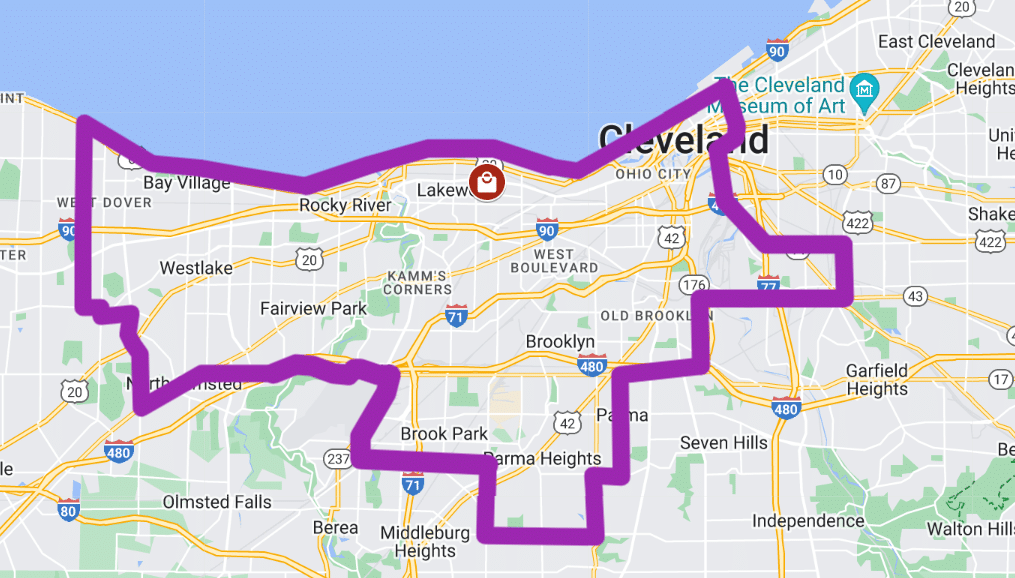
Our service area is inside the purple line. We service homes outside of the purple line. However, a “trip charge” will be incurred to account for longer drive times.
Out of Area “Trip Charge”
For locations outside the purple line- up to forty minutes from the office, a “trip charge” of $50 per visit applies for single services and non-warrantied follow-up visits. Add $100 for multi-visit service plans. We do not service homes over 40 minutes away. During the busy April-October season, we might be unable to service homes outside the purple line. We are likelier to take jobs to the West than jobs further away to the South or East.
Get A Price Quote Emailed To You
Request a free no obligation consultation to discuss your needs.
Get In Touch
Lakewood Exterminating
#8,
Email: lakewoodexterminating@gmail.com

Cleveland Pest Control Services
Child And Pet-Friendly Treatments From Trusted Exterminators
Lakewood Exterminating
#8,
Email: lakewoodexterminating@gmail.com