

Project Description
Spiders in Ohio – Information and Facts
Spiders in Cleveland, Ohio
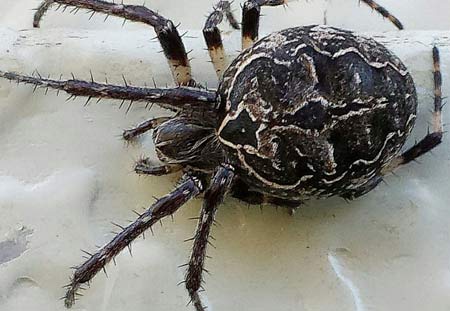 Ohio has a lot of spiders. Ohio State puts the statewide list at about 620 species. Most of them never come indoors, and almost none of them can do more than annoy you. A handful can leave a mark. Two have a reputation that runs well ahead of how often anyone in Cuyahoga County actually meets one.
Spiders hunt in more than two ways. Some chase or ambush prey and never use a web to catch food. Jumping spiders and grass spiders fall in that group. Orb weavers sit in a round web and wait. Cobweb spiders, including the widows, build the tangled webs in corners, window frames, and clutter. Tarantulas are not part of the Ohio fauna. If someone in Lakewood thinks they have one, it arrived in a box
Dangerous Spiders
People ask about two. Widows, and the brown recluse. One of those is a rare native. The other does not live here.
Brown Recluse Spiders
The brown recluse is not found in Ohio. Ohio State says there is no documented population anywhere in the state, and verified specimens are extremely rare. The native range is the southern and central Midwest. There are no established populations in the northern third of Ohio. A spider in a Cleveland basement is not a recluse that came in from the cold. If one is ever confirmed here, it was carried in with furniture, boxes, or goods from a state where they actually live, and it is a single animal, not an infestation.
They are shy. They do not roam open floors looking for someone to bite. A bite, when it happens in a place they actually live, is usually a spider pressed against skin in clothing, bedding, or stored items. Do not expect a spider to jump out of a web and bite you because you walked past it.
Most brown recluse bites reported in Ohio are something else. A skin infection, a tick bite, or a reaction to another insect gets blamed on a spider nobody captured. A swollen mark that showed up overnight is often closer to a bed bug bite than a spider bite. If you have a spider and you want it identified, send a clear photo. If you have a wound and no spider, a doctor is the right call, not a pest treatment for a species that is not established here.
Brown Recluse Identification
A lot of Ohio spiders get called recluses because of a dark mark on the front half of the body. The violin shape is a clue, not an ID. Several local spiders have a similar mark. A recluse has six eyes, set in three pairs, not the eight eyes most spiders have. The body is pale brown to reddish brown, with long legs and no spines. The abdomen has no pattern. If the spider in your photo has distinct markings on the abdomen, or stout spines on the legs, it is not a recluse.
Black Widow Spiders
Black widows occur in Ohio, and finding one is still uncommon. They stay in sheltered, undisturbed spots: woodpiles, meter pits, abandoned outbuildings, clutter that nobody moves. They are not a routine kitchen pest.
There are two species, and the ranges on a lot of older write-ups are flipped. The northern black widow is the one found throughout Ohio, including the northeast. That is the widow a Cleveland homeowner might actually encounter. The southern black widow is a southernmost-Ohio spider. It is not the common widow south of Cleveland, and the northern species is not a western-Ohio specialty.
The venom is a neurotoxin. A bite hurts right away and can bring muscle cramps and spasms. In a healthy adult it is rarely life-threatening. Anyone bitten should still get medical care, especially a child, an older adult, or anyone who already feels sick. Pain from a widow bite shows up immediately. That is one of the practical differences from the slow-building sores people blame on recluses.
Black Widow Identification
Both widows are glossy black with red or white marks. The hourglass is on the underside of the abdomen, so you will not see it from above while the spider sits in a web. On the northern black widow that hourglass is broken into two separate marks. On the southern black widow it is a single shape, broader on one end. Males are smaller, lack the full underside marking, and are not the spiders that turn up in bite reports.
Other Species of Concern
A few other spiders get blamed for bites. Grass spiders, bold jumping spiders, and yellow sac spiders are the ones people in this area actually find.
Grass Spiders
Grass spiders are common in Ohio yards. They build a sheet web with a funnel, in grass, ground cover, and the corners of foundations. The sheet is not sticky. It trips the insect, and the spider runs out of the funnel and grabs it. By fall they are large enough to notice, and some move into garages and basements when the weather turns. They are fast and they retreat. A bite is unlikely. If one happens because a spider was pinned against skin, it hurts and then it is over.
Bold Jumping Spiders
Bold jumping spiders hunt on sight, in daylight, around windows, decks, and siding. They stalk and then jump. The jump looks dramatic and it is aimed at an insect, not at you. They avoid people. Catching one by hand is the hard part, which is also why accidental bites are rare.
Yellow Sac Spiders
Yellow sac spiders are a real indoor spider here. They are pale yellow, they hunt at night, and during the day they sit in a small white silk sac, often where the wall meets the ceiling. If one gets trapped against your skin, in a sleeve or under a collar, it can bite. The bite is painful. It is not a brown recluse bite, and it does not turn into the wound people picture when they hear that name. They are often blamed for skin problems that were never a spider bite.
Furrow Orb-Weaver Spiders
Furrow orb-weavers are the spider people on the Lake Erie shore complain about. They are out at night. Webs go up along windows, porch ceilings, play sets, garages, and light fixtures, because that is where midges, mayflies, and mosquitoes pile up coming off the lake. They will also take other spiders, and they build where ants are flying. A swarm a couple of days after a rain is a reliable meal.
They are the orb weaver you notice first in spring, because they get through an Ohio winter. Once the spring rains push ant swarms, the webs multiply. They are not dangerous to people. They eat pests. They are also relentless about the porch light, which is why they end up on a pest list at all. When the webs are across the door every morning, that is a spider control visit, not a reason to fog the whole house.