Ventilate the area for 30 minutes, never sweep or vacuum dry droppings, spray them with disinfectant until soaked, wait five minutes, then wipe up with paper towels. Wear gloves, and wash hands afterward.
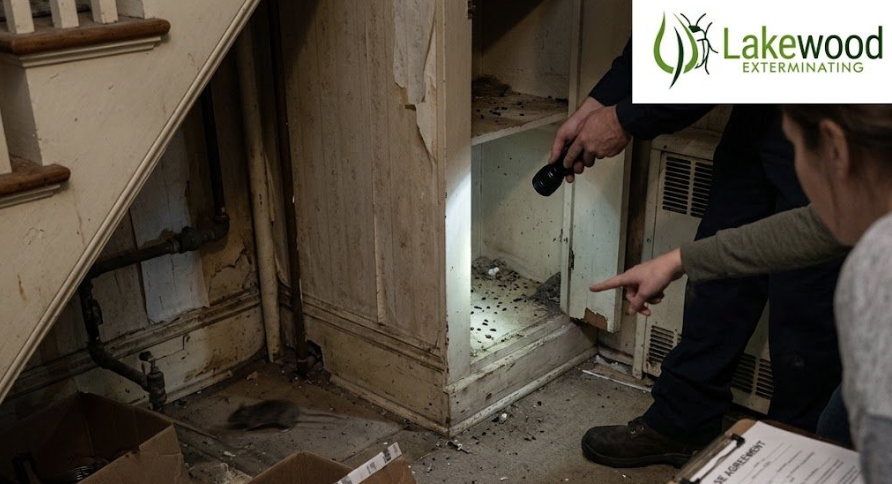
The mice are gone, the traps are quiet, and now you are staring at what they left behind: droppings in the cabinet corners, shredded insulation in the attic, maybe a nest behind the water heater. At Lakewood Exterminating, we tell every customer the same thing at the end of a service: the cleanup matters as much as the treatment, because what mice leave behind can make you sick long after the last mouse is gone.
The good news is that safe cleanup is simple once you know the rules. Here is the health risk in plain terms, the gear and setup, the exact steps, and the short list of things you should never do.
Why Mouse Droppings Are a Health Risk
Mouse droppings, urine, and nesting material can carry pathogens, and the dangerous part is not touching them. It is breathing them. Dried droppings crumble into fine particles, and the moment you sweep or vacuum, those particles go airborne and straight into your lungs. That is the route that matters, not skin contact.
Which mouse you had changes the risk level. Deer mice are the known carriers of hantavirus, a serious respiratory illness that can be fatal, while house mice are linked more to salmonella and allergy-triggering proteins in their droppings and urine. If you are not sure which one was in your home, our guide to house mouse vs deer mouse in Ohio shows you how to tell them apart. In doubt, treat all droppings as potentially infectious, because that is what every public health agency recommends.
For a sense of how seriously doctors take this, University of Utah Health’s hantavirus guide explains that sweeping dry droppings aerosolizes the virus particles, and that hantavirus pulmonary syndrome can be fatal. CDC puts the death rate at about 38 percent. That is rare, and house mice are not the usual carrier, but it is exactly why the cleanup rules below exist.
Safety Setup Before You Touch Anything
Five minutes of setup is the difference between cleaning up and breathing it in. Before you start:
- Ventilate. Open doors and windows and let the space air out for at least 30 minutes. Leave the room while it airs, and keep cross-ventilation going while you work.
- Gear up. Rubber or nitrile gloves, always. For anything beyond a few droppings, add a well-fitting N95 mask. Skip the dust mask from the hardware store junk drawer; it is not the same thing.
- Keep kids and pets out of the area until the cleanup and disinfection are completely done.
- Mix your solution: household disinfectant, or about 1.5 cups of bleach per gallon of water, roughly a 1-to-10 mix. Put it in a spray bottle.
- Never sweep or vacuum dry droppings. Not a quick pass, not just this once. Dry contact is what puts particles in the air.
Step by Step: How to Clean Up Mouse Droppings
Once the area is ventilated and you are gloved up, the process is the same everywhere in the house:
- Soak. Spray the droppings and the surrounding area with your disinfectant or bleach solution until everything is thoroughly wet. The moisture is the whole point; it keeps particles locked down.
- Wait. Give it at least five minutes of contact time so the disinfectant can actually work.
- Wipe. Pick everything up with paper towels, working from the outside of the mess inward.
- Bag it. Drop the towels and waste into a plastic bag, seal it, and put it straight into an outdoor trash can with a tight lid.
- Disinfect again. Mop or sponge the area with fresh solution, then let it air dry.
- Wash up. Wash your gloved hands before removing the gloves, then wash your bare hands with soap and warm water.
| Item or surface | How to clean it | Notes |
|---|---|---|
| Hard floors and countertops | Spray, soak 5 minutes, wipe, then mop with disinfectant | Let surfaces air dry; do not rinse away the disinfectant early |
| Dishes and utensils | Run through the dishwasher or hand-wash in hot soapy water | Do this after the surrounding area is cleaned |
| Carpets and rugs | Shampoo or steam-clean after spot-disinfecting droppings | Never dry-vacuum the droppings first |
| Upholstered furniture | Spot-disinfect, then steam-clean where possible | Heavy contamination on cheap furniture may not be worth saving |
| Clothing and bedding | Machine-wash hot with detergent | Handle contaminated laundry with gloves until washed |
| Attic or crawl space insulation | Remove soiled sections bagged and gloved | Heavy contamination is a pro job; see below |
Cleaning Up Nests and Dead Mice
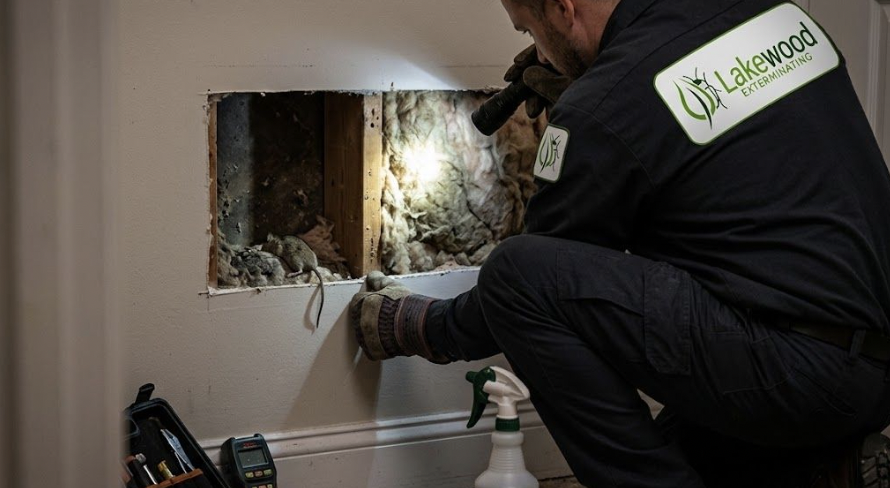
Nests and carcasses get the same treatment, just more of it. Soak the nest or the dead mouse thoroughly with disinfectant, let it sit, then pick it up with a tool or gloved hands inside a bag, double-bag it, and send it to the outdoor trash. Do not handle a dead mouse bare-handed even for a second.
The harder case is the mouse you can smell but cannot find. A carcass inside a wall void will usually stop being a health concern once it dries out, but the odor can hang around for weeks, and it tells you something useful: there was a population big enough to lose one. If that is where you are, our guide to dead mouse smell in walls covers how long the odor lasts and what actually helps while you wait it out.
The Never-Do List
Most cleanup mistakes come from speed. These five cover nearly all of them:
| Never do this | Do this instead |
|---|---|
| Dry-sweep or vacuum droppings | Soak with disinfectant first, then wipe with paper towels |
| Handle droppings, nests, or carcasses bare-handed | Rubber or nitrile gloves every time, washed before removal |
| Use a dust mask for heavy contamination | A well-fitting N95, or call a professional for attic-scale jobs |
| Toss waste in the kitchen trash | Double-bag it and use an outdoor can with a tight lid |
| Start cleaning the moment you find the mess | Ventilate the space for 30 minutes first, and stay out while it airs |
After the Exterminator Leaves: Post-Treatment Sanitation
Post-exterminator mouse sanitation has its own rules, because some of what we leave behind is working equipment. Do not move, open, or throw out bait stations or traps we placed; they are still doing their job and, on a plan, we maintain them ourselves. Everything else, the old droppings, the rub marks, the nesting scraps, should get the full cleanup treatment above once control is underway.
There is a smart reason to clean thoroughly after a mouse control service: a clean slate turns your house into a monitoring tool. Once every old dropping is gone, any new dropping you find is fresh evidence, dated for free. That makes your follow-up visits far more precise, because you can show us exactly where activity restarted instead of guessing.
At Lakewood Exterminating, we also offer a sanitation and droppings cleanup service from November through March, using disinfectants, odor encapsulation products, and HEPA-filter vacuums, billed hourly. The very largest jobs, like a badly soiled attic with ruined insulation, still call for a bio-remediation company, and we will tell you honestly when yours does. Most homes never need either; the spray, soak, wipe routine above covers it.
Frequently Asked Questions
Can you get sick from cleaning up mouse droppings?
Yes, if you do it dry. Sweeping or vacuuming dried droppings launches virus and bacteria particles into the air you breathe, which is how hantavirus and salmonella exposure happen. Wet cleaning with disinfectant first takes that route off the table.
Is it ever safe to vacuum mouse droppings?
Not while they are dry, and not with a regular vacuum, which blows fine particles straight through the filter and back into the room. Soak, wipe, and bag first. If a large area needs vacuuming afterward, that is a HEPA-filter job, and heavy cases belong with professionals.
What disinfectant should I use on mouse droppings?
A household disinfectant spray works, and so does a bleach solution of about 1.5 cups of bleach per gallon of water, roughly 1 part bleach to 10 parts water. Whichever you use, the contact time matters: soak the area and give it at least five minutes before wiping.
Do house mice in Ohio carry hantavirus?
Hantavirus in the U.S. is carried mainly by deer mice and a few other wild species, not the common house mouse. House mice bring their own risks, including salmonella and allergy triggers, so the safe cleanup rules apply to both. If you never saw the mice, assume the stricter standard.
Should I clean up droppings before or after extermination?
After control is underway. Cleaning first does not help if mice are still active, because they will recontaminate the area tonight. Once treatment is working, a full cleanup gives you a clean baseline, and any new droppings after that point are useful evidence to share with your technician.
How do I get rid of the smell after cleanup?
Ventilation plus disinfection handles most odor. A dead mouse inside a wall void is different: the smell fades as the carcass dries out, usually over a couple of weeks, and odor absorbers help in the meantime. Persistent strong odor can mean multiple carcasses or a larger issue worth a call.
When is mouse cleanup a job for professionals?
When the contamination is heavy or in the wrong place: a badly soiled attic, droppings inside ductwork, or a crawl space with years of accumulation. Those jobs need proper PPE, HEPA equipment, and disposal discipline, and they are where DIY stops being worth the risk. Our sanitation service handles many of them; the largest go to a bio-remediation company.
Stop the Source First
Cleanup only stays done if the mice stay gone, and that starts with control and exclusion, not bleach. If you still have activity, or you want a professional set of eyes on the entry points before you invest a weekend in cleaning, book a mouse control visit or call Lakewood Exterminating at (216) 466-2486. We will get the source stopped first, then this guide takes it from there.